

#HimaEcoMedia
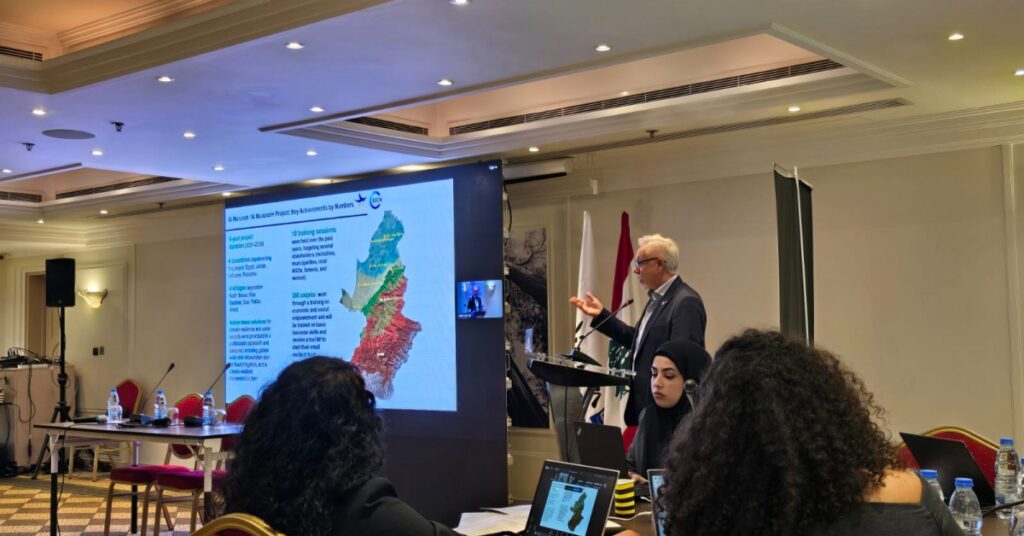
Beirut — At a pivotal moment in Lebanon’s efforts to strengthen its resilience to climate change, the capital hosted a high-level regional dialogue titled “Financing Climate Adaptation through Resilient Nature-Based Water Solutions: Regional Insights Shaping Lebanon’s Path.” The event took place on February 10, 2026, at the Radisson Blu Martinez Hotel, bringing together the Deputy Head of Mission at the British Embassy in Beirut, the Water Advisor at the Ministry of Energy and Water, the Al Murunah Project Lead at the International Water Management Institute (IWMI), representatives from the International Union for Conservation of Nature (IUCN) West Asia Regional Office, environmental organizations, and experts from Jordan, Egypt, and Lebanon.
The dialogue was convened under the Al Murunah project, supported by UK International Development and implemented by IWMI in partnership with IUCN and the Society for the Protection of Nature in Lebanon (SPNL). The initiative aims to advance climate adaptation pathways while strengthening water security and natural resource management, particularly in the country’s most vulnerable areas.
The meeting took place against the backdrop of mounting challenges facing Lebanon, driven by climate change, environmental degradation, and socio-economic pressures. The deterioration of watersheds, deforestation, and unplanned urban expansion are intensifying the risks of floods, droughts, and wildfires—threatening water security, agricultural productivity, ecosystem health, and rural livelihoods. The dialogue also coincided with the Lebanese government’s progress in implementing its updated Nationally Determined Contribution (NDC) and National Adaptation Plan (NAP), alongside growing regional momentum around nature-based solutions and heightened international interest in financing climate adaptation ahead of COP31.
In this context, resilient nature-based water solutions emerged as a practical approach that integrates environmental interventions—such as water harvesting, watershed restoration, agroecology, and natural flood management—with local governance and social measures to reduce climate risks and support rural communities.
The Al Murunah project in Baalbek focuses on flood risk reduction, enhanced groundwater recharge, and the protection of agricultural lands and neighboring communities through nature-based flood management and watershed restoration, implemented in close collaboration with municipalities and local stakeholders. Participants underscored that building sustainable climate resilience requires more than technical solutions; it demands inclusive local governance, strong community leadership, and the active participation of women, farmers, and local institutions in both planning and implementation.
Remarks Emphasize the Power of Partnerships
The dialogue opened with official remarks highlighting the importance of international partnerships and collective action in addressing climate challenges.
Victoria Dunn, Deputy Head of Mission at the British Embassy in Beirut, affirmed that the United Kingdom’s support for the project reflects its commitment to strengthening partner countries’ capacity to adapt to climate change. She noted that nature-based solutions represent a strategic investment that simultaneously protects the environment and promotes economic and social stability.
Suzy Hayek, Water Advisor at the Ministry of Energy and Water, stressed the importance of aligning initiatives with national policies, emphasizing that strengthening integrated water resources management has become a national priority amid escalating climate pressures.
Stephen Fragaszy, Al Murunah Project Lead at IWMI, explained that the project seeks to translate climate commitments into investable and actionable interventions, underscoring that collaboration with municipalities and local communities is the cornerstone of scalable and sustainable solutions.
Ali Hijazi, Water and Climate Change Programme Manager at the IUCN West Asia Regional Office, highlighted the region’s wealth of replicable expertise, noting that expanding nature-based solutions opens new pathways for accessing climate finance and fostering more resilient development.
Assaad Serhal, Director General of SPNL, presented the Hima approach as a pioneering model for community-based natural resource management. He reviewed its expansion across several Lebanese regions and its role in safeguarding ecosystems while creating sustainable development opportunities, emphasizing that genuine community engagement remains the strongest guarantee of long-term environmental success.
Regional Expertise and Innovative Finance
The program featured a panel discussion titled “Climate Finance for the Water–Agriculture–Climate Nexus: Regional Experiences,” moderated by Stephen Fragaszy and joined by experts from Egypt, Jordan, and international financial institutions. The session showcased successful experiences in designing bankable projects, highlighted the importance of public–private partnerships, and stressed the need to embed sustainability within banking and investment strategies.
Dalia Saad, Assistant Minister of International Cooperation of Egypt for collaboration with the European Investment Bank (joining virtually), emphasized that developing finance-ready projects requires clearly defined national priorities and institutional frameworks capable of efficiently managing climate investments.
Christelle Cooper, Deputy Country Representative of the Global Green Growth Institute (GGGI) in Jordan, noted that nature-based solutions have evolved into a development instrument capable of delivering economic and social returns alongside environmental impact.
Ruba Al-Zu’bi, Regional Lead for Energy, Climate, and Environment at the UK’s Foreign, Commonwealth & Development Office (Jordan), underscored that policy alignment with international financing requirements is a critical step toward accelerating adaptation projects.
Mona Bedeir of the Commercial International Bank in Egypt observed that the banking sector is becoming increasingly engaged in sustainability finance, adding that financial institutions are actively seeking projects with measurable impact and well-assessed risk profiles.
The session also featured an intervention by Fadi Ghanem, President of the Ghadi Association and IUCN Members’ Coordinator in Lebanon, who highlighted the strategic role of environmental media in supporting climate action. He stressed its importance in raising public awareness, strengthening accountability, and enhancing the attractiveness of environmental initiatives to potential funders, noting that investment in specialized media has become an integral component of the adaptation and sustainability ecosystem.
Practical Outcomes to Advance Lebanon’s Adaptation Path
The dialogue generated a set of actionable outcomes. Participants agreed on identifying priority climate and water challenges that can be addressed through resilient nature-based water solutions in alignment with national adaptation plans. A shortlist of five to seven project concepts with strong development and financing potential was also prepared, forming a valuable pipeline for Lebanon’s climate adaptation financing efforts.
The meeting further strengthened coordination among national institutions, municipalities, and international partners, fostering a shared understanding of climate finance mobilization, project implementation, and scaling strategies. It also highlighted the central role of local communities—particularly women and farmers—in leading adaptation efforts.
In closing, participants agreed to prepare a comprehensive brief summarizing the key discussions, recommendations, and implementation steps related to the advancement of the Al Murunah project. The document will be circulated among stakeholders and published in both Arabic and English.
The outcomes of this dialogue are expected to provide a significant boost to positioning nature-based solutions as a practical pathway for Lebanon to access international climate finance and build effective partnerships that enhance its capacity to confront environmental challenges—paving the way for stronger engagement in upcoming global climate milestones, foremost among them COP31.
-
- No related articles found
-
- No most read articles today